.svg)
.svg)
Calming strategies are the tools, routines, and supports that help a child feel safe and regulated before, during, and after moments of distress. Children with autism may experience anxiety, sensory overload, communication difficulties, and challenges with unexpected changes. These experiences can sometimes lead to distress, withdrawal, shutdowns, or meltdowns.
The right calming strategy depends on the individual child. What helps one child feel regulated may be uncomfortable or ineffective for another. Understanding a child’s sensory preferences, communication style, routines, and triggers can help caregivers provide more personalized support.
This guide explores practical calming strategies for children with autism, including sensory supports, visual tools, communication aids, predictable routines, positive reinforcement, and professional therapies.
What Can Cause Emotional Overwhelm in Autistic Children?

Emotional dysregulation can have several contributing factors. Common triggers may include:
- Sensory overload from sounds, lights, smells, textures, or crowded environments
- Difficulty communicating wants, needs, discomfort, or emotions
- Unexpected changes to routines or plans
- Difficult social situations
- Anxiety or uncertainty
- Physical discomfort
- Difficulty transitioning between activities
- Fatigue, hunger, or other environmental stressors
Autistic people can experience sensory input differently from non-autistic people. Some may be more sensitive to certain sounds, lights, textures, smells, or temperatures, while others may seek additional sensory input.
The CDC notes that unusual reactions to sensory experiences can be associated with autism, including reactions to the way things sound, smell, taste, look, or feel.
For more information about different sensory patterns, see Apricott’s guide to Sensory Seeking vs. Sensory Avoiding in Children.
Understanding Sensory Overload
Sensory overload occurs when sensory information becomes difficult for a person to process or tolerate. For an autistic child, an otherwise ordinary environment may become overwhelming because of noise, lighting, movement, touch, smells, or several sensory inputs occurring at once.
A child experiencing sensory overload may:
- Cover their ears or eyes
- Try to leave the environment
- Become quieter or withdraw
- Cry or appear distressed
- Become restless or agitated
- Repeat movements or sounds
- Have difficulty communicating
- Experience a meltdown or shutdown
Sensory differences are common in autism, but they are not unique to autism. Research has identified several sensory patterns, including hyper-responsiveness, hypo-responsiveness, and sensory seeking.
Sensory Seeking vs. Sensory Avoiding
There is no single sensory profile that applies to every autistic child. A child’s needs can also change depending on the situation.
Create a Calm, Sensory-Friendly Environment
One of the simplest ways to support a child who is becoming overwhelmed is to reduce unnecessary sensory demands.
A calming space does not need to be elaborate. It could be a quiet corner of the child’s bedroom, a small area with comfortable seating, or another familiar place where the child feels safe.
Consider:
- Lowering harsh or bright lighting
- Reducing unnecessary background noise
- Limiting strong smells
- Providing comfortable clothing and textures
- Keeping favorite calming items nearby
- Allowing the child to take a break from busy environments
- Keeping the space predictable and familiar
Autism Speaks notes that sensory overload can result from intense sensory stimuli and may create anxiety, a desire to escape, or difficulty communicating.

Use Predictable Routines and Visual Supports
Unexpected changes can be stressful for some autistic children. Predictable routines and visual supports can make transitions easier by showing children what to expect.
Useful tools include:
- Picture-based schedules
- Visual timers
- First-then boards
- Countdown charts
- Written instructions
- Emotion charts
- Visual reminders for transitions
For example, instead of simply saying, “Five more minutes and then we’re leaving,” a caregiver might use a visual timer and show the child what activity comes next.
A routine should still allow for flexibility. The goal is not to make every part of a child’s day rigid, but to provide enough predictability to reduce unnecessary uncertainty.
IMAGE IDEA Clean flat illustration of a first-then board next to a visual timer, using simple picture cards (for example, "tidy up" then "watch show"). Apricott green with apricot accents.
Teach Calming Skills Before a Child Becomes Overwhelmed
Calming strategies are usually easier to practice when a child is already calm.
Depending on the child’s abilities and preferences, caregivers can practice:
- Slow breathing
- Asking for a break
- Moving to a quiet area
- Using a preferred sensory activity
- Looking at a visual emotion scale
- Requesting help
- Listening to calming music
- Engaging in a familiar quiet activity
The goal is to help children gradually recognize what they are feeling and learn ways to communicate what they need.
Not every child will benefit from breathing exercises or verbal emotional strategies. A child who communicates primarily through AAC, gestures, pictures, or other methods should have calming strategies that match their communication needs.
Use Sensory Tools Carefully and Individually
Some children find certain sensory tools helpful, while others may find them distracting or uncomfortable.
Potential options include:
- Fidget toys
- Stress balls
- Textured objects
- Noise-reducing headphones
- Movement activities
- Comfortable seating
- Lap pads
- Other sensory items recommended by a qualified professional
Weighted blankets and other deep-pressure products should not automatically be considered appropriate for every child. Sensory interventions have varying levels of evidence, and research has found that outcomes can differ considerably between approaches and individuals.
If you are considering a particular sensory intervention, discuss it with an appropriately qualified professional who understands the child’s individual needs.
Offer Breaks and a Safe Place to Regroup
A break can give a child an opportunity to step away from a stressful activity or environment.
A break might involve:
- Sitting somewhere quiet
- Listening to music
- Looking at a favorite book
- Using a preferred sensory item
- Engaging in a familiar activity
- Spending a few minutes away from a crowded environment
A safe space should not be used as punishment. Instead, children can be taught that it is a place they can use when they need time to regroup.
Autism Speaks recommends establishing a safe place where a child can calm down or move away from overwhelming situations, while also teaching the child how and when to use that space.
Support Communication During Overwhelm
Communication difficulties can contribute to frustration when a child cannot easily express what they need.
Augmentative and Alternative Communication (AAC) can provide another way for some children to communicate. Depending on the individual, AAC may include:
- Picture cards
- Gestures
- Communication boards
- Sign language
- Speech-generating devices
- Tablet-based communication systems
A child may use AAC to communicate messages such as:
- “I need a break.”
- “It’s too loud.”
- “I don’t like this.”
- “Help.”
- “I’m finished.”
The CDC notes that some autistic people communicate through signs, gestures, pictures, or electronic communication devices rather than spoken language.
For additional information, Autism Speaks provides resources about assistive technology and AAC.
Make Transitions More Manageable
Transitions can be difficult when a child has to stop a preferred activity, move somewhere new, or adjust to an unexpected change.
Helpful strategies include:
- Give advance warnings before transitions
- Use a visual timer
- Show what activity comes next
- Use a first-then statement
- Offer limited choices where appropriate
- Allow a familiar transitional object
- Keep instructions short and clear
- Give the child enough processing time
For example:
First: Put the toys away.
Then: Watch your favorite show.
Offering appropriate choices can also give children a sense of control. Instead of asking an open-ended question, try:
“Do you want to put your shoes on first or your jacket?”
Use Clear, Concrete Communication
Long explanations can be difficult to process when a child is already distressed.
Instead, use:
- Short sentences
- Simple instructions
- A calm voice
- Visual cues
- One direction at a time
- Extra processing time
During significant distress, reducing the amount of language may be particularly helpful. The Autism Research Institute notes that once someone is experiencing a significant meltdown, standard behavioral cues may be difficult to respond to, making calm, simple support more appropriate.
Use Redirection When Appropriate and Positive Reinforcement
Redirection can sometimes help a child move from an escalating situation toward a safer or more manageable activity.
For example, a caregiver might:
- Offer a preferred activity
- Provide an appropriate sensory item
- Suggest moving to a quiet space
- Offer two acceptable choices
- Help the child communicate what they need
Positive reinforcement can also encourage useful skills. Specific praise tells the child exactly what they did successfully.
Instead of “Good job.” try “Great job asking for a break.”
This helps connect the child’s communication or coping skill with positive feedback.
What Should You Do During a Meltdown?
A meltdown is different from a tantrum. During a meltdown, a child may be experiencing intense distress or sensory and emotional overload.
The priority should be safety, reducing demands, and helping the child feel secure.
During a Meltdown
- Stay calm
- Reduce unnecessary noise and stimulation
- Give the child physical space
- Use as few words as possible
- Remove unsafe objects when necessary
- Avoid arguing or demanding explanations
- Allow time for the child to recover
- Offer familiar calming supports when appropriate
Trying to force a child to stop a meltdown immediately may increase distress. Instead, focus on reducing the factors contributing to the overwhelm.
Once the child has recovered, caregivers can consider what happened beforehand and whether there were identifiable triggers.

Matching Strategies to Common Situations
Every child is different, but this quick reference can help caregivers decide where to start.
How Can ABA Therapy Support Emotional Regulation?
Applied Behavior Analysis (ABA) is one approach that may be used to support autistic children with communication, daily living, social, and behavioral skills.
A personalized ABA program may help a child:
- Develop functional communication
- Learn to request a break or assistance
- Practice coping skills
- Build independence
- Learn new daily living skills
- Develop skills across different environments
- Identify and address patterns associated with challenging behaviors
ABA should be individualized to the child’s needs, strengths, preferences, and goals rather than following a one-size-fits-all program.
Children may receive different types of therapy depending on their needs. Learn more about Types of Therapy for Autism.
For children who may benefit from behavioral support, a professional Autism Evaluation can help families understand their child’s developmental needs and determine what support may be appropriate.
When Should a Child Be Evaluated?
If a child is experiencing frequent distress, communication difficulties, sensory challenges, developmental concerns, or behaviors that interfere with daily life, parents may wish to discuss these concerns with a healthcare or developmental professional.
An autism evaluation may help clarify whether a child’s developmental characteristics are consistent with autism and identify areas where additional support may be useful.
The CDC explains that autism diagnosis involves developmental history and behavioral assessment rather than a single medical test.
Supporting Children With Different Needs
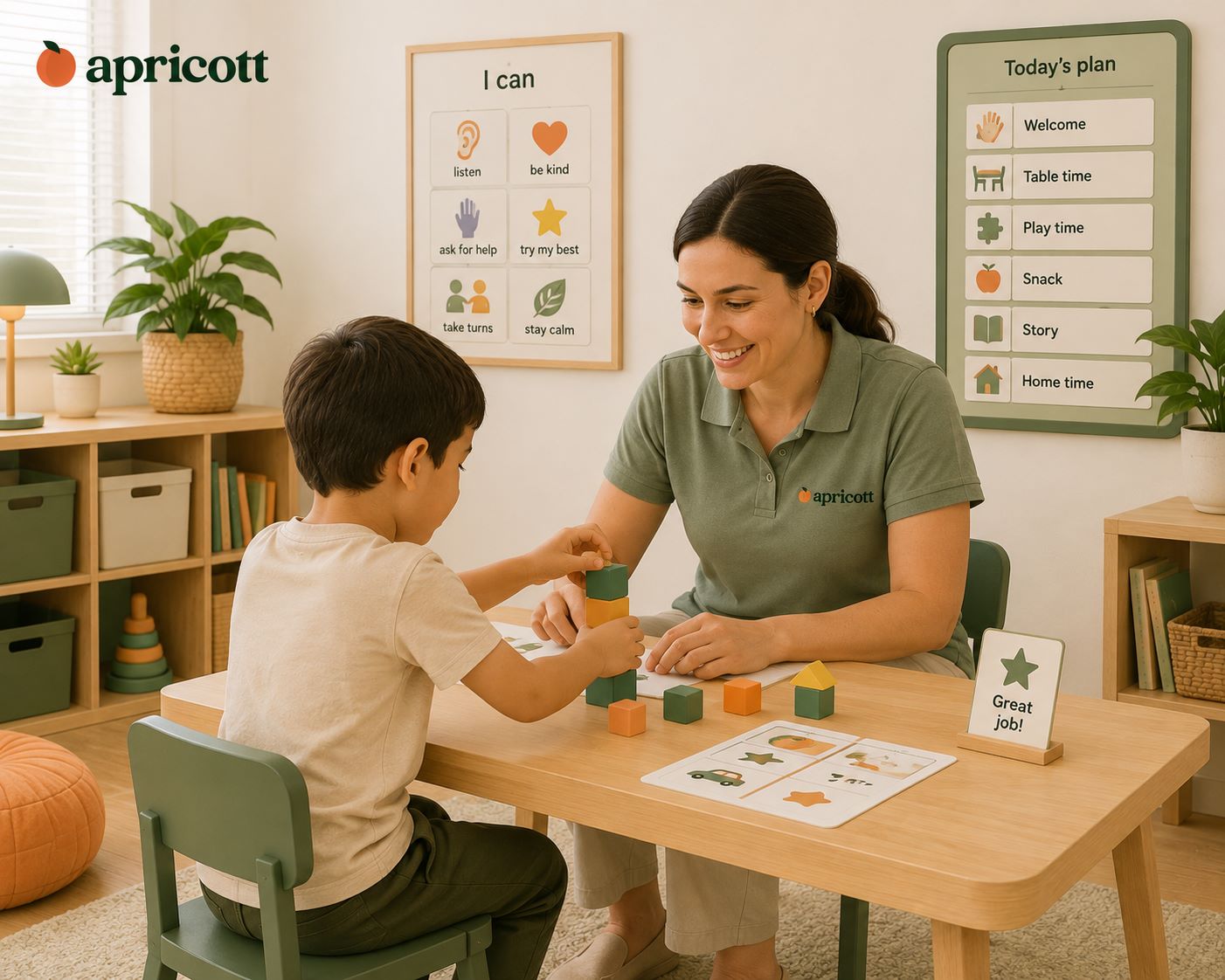
Every autistic child is different. A strategy that works well for one child may not work for another.
Some children may benefit from sensory modifications, while others may respond better to visual supports, movement, communication tools, predictable routines, or a combination of approaches.
It is also important to avoid assuming that every behavior is caused by autism. Anxiety, ADHD, sleep difficulties, physical discomfort, and other co-occurring conditions can affect emotional regulation.
Parents looking for broader information can explore Apricott’s Autism Statistics resource for additional context about autism in the United States.
Families in North Carolina can also find local information and support through Apricott’s North Carolina Autism Resources.
For families researching other developmental or neurological conditions that may overlap with certain behaviors, Apricott also discusses the relationship between Tourette Syndrome and Autism.
References and Additional Resources
- Centers for Disease Control and Prevention (CDC): Signs and Symptoms of Autism Spectrum Disorder
- Centers for Disease Control and Prevention (CDC): Screening for Autism Spectrum Disorder
- Centers for Disease Control and Prevention (CDC): Treatment and Intervention for Autism Spectrum Disorder
- National Institute of Mental Health (NIMH): Autism Spectrum Disorder
- National Center for Biotechnology Information (NCBI): Interventions Targeting Sensory Challenges in Children With Autism Spectrum Disorder
- Autism Speaks: Sensory Issues
- Autism Speaks: Ideas for Preventing Challenging Behavior at School
- Autism Speaks: Technology and Autism
- Autism Research Institute: Meltdowns and Calming Techniques in Autism